

Maestro


 |
 |
 |
Maestro
Description
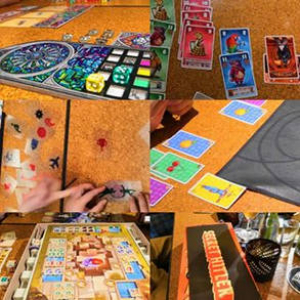
Maestro is a strategy game for 1-4 players in which the workshops of Leonardo da Vinci and Michelangelo compete for fame across Renaissance Italy. Place artwork, influence collectors, and claim majorities in prestigious galleries.-
The Renaissance has ignited a golden age of creativity and fierce competition. In Maestro, two legendary workshops – one led by the visionary Leonardo da Vinci, the other by the master sculptor Michelangelo – compete for glory, influence, and immortal fame. From the art-filled streets of Florence to the opulent courts of Milan and Rome, your workshop will craft masterpieces, shape cultural trends, and win the favor of powerful aristocrats.
Will you refine your techniques in solitude, showcase your works across Italy, or influence the courts to bend the public's tastes in your favor? Each workshop may be controlled by a solo player or a team of two. Players alternate turns using action cards to gain majorities in prestigious galleries and to earn the support of influential nobles who grant powerful abilities and alternative scoring opportunities. With asymmetrical abilities and distinct playstyles – Leonardo's workshop focuses on patient build-up, while Michelangelo's thrives on bold, immediate impact – every decision shapes your legacy.
Maestro is a competitive game between two workshops: Leonardo da Vinci's and Michelangelo's. Each workshop can be controlled by either one player or a team of two, with slight rule differences depending on the setup. Each player may only interact with their own artwork. The workshop differences are:
Michelangelo's Workshop: the active player can interact only with Busts or Statues, the type depending on the Character indicated by the Tools tile on the Sideboard.
Da Vinci's Workshop: there is only one type of artwork – Paintings.
During the game, galleries across the map of Italy change in popularity. A key objective is to have the majority of your artwork in regions with galleries. Victory Points depend on whether the gallery is Popular or Secondary, and on the level of Collectors' Influence.
A game of Maestro is played over 4 rounds, each divided into five phases resolved in order: Planning Phase, Preparation Phase, Action Phase, Exhibition Phase, and Cleanup Phase. After the fourth round's Exhibition Phase, players proceed to Final Scoring.
In the Planning Phase, if you are playing as a team leading a single workshop, this is the only phase where teammates may openly discuss strategy. Both workshops resolve the Preparation Phase simultaneously, following rules based on the number of players in each workshop.
In the Action Phase, on your turn you choose one of four main actions:
Move – spend Action Points to move your artwork; each Action Point allows you to move one artwork to an adjacent region on the main board.
Influence – spend Action Points to manipulate Collectors; move one standing Collector from one area of the Collector Lodge to another, lay it down, and gain 1 Resource matching the color of the area it left.
Create – gain 1 Artwork at the start of this action, then resolve based on the card's Effort: place 1 Artwork per Action Point into Florence, or place 1 Artwork into each region with a Gallery where your workshop has the majority.
Study – for each Action Point, advance your Study marker by 1 space and resolve the corresponding effect, which may grant resources, upgrade your action card deck, or upgrade your workshop.During the Exhibition Phase, players gain Victory Points based on their artistic influence across Italy. During the Cleanup Phase, the game state resets in preparation for the next round.
Victory goes to the workshop with the most Victory Points, earning lasting fame and glory in the world of Renaissance art.
Category :GamersNumber of Players
 :1-4Playing Time
 :90-140 min.Age
 :14 +Language
 :englishCooperative Game
 :NoPublisher:Type of game:
-
Watchdog - Product monitoring (price/availability)
Enter your email address, we will inform you about price changes or product availability.
 |
4/792 |  |


Ludopolis s.r.o., Jégého 14
821 08 Bratislava
Slovak Republic
Our store address:
Záhradnícka 95 – Radošinské Naive Theatre building
1st floor
821 05 Bratislava
VAT ID: SK 2024029755